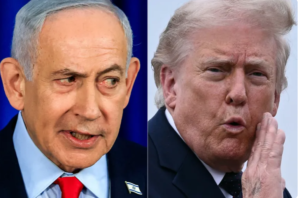
Experts say the latest confrontation has laid bare growing divisions between the two leaders.

The latest flare-up in hostilities between Israel and Iran has exposed what some observers say is the most significant crack yet in the relationship between Israeli Prime Minister Benjamin Netanyahu and United States President Donald Trump, revealing increasingly divergent interests between the two leaders.
The pair once appeared politically inseparable, with Netanyahu describing Trump as the “greatest friend Israel has ever had in the White House”. Trump returned the praise. During a 2025 appearance in Israel, he joked, “He’s not easy – not the easiest guy to deal with – but that’s what makes him great.”
Trump is no longer joking. Last week, he reportedly called Netanyahu “f***ing crazy” during a phone call, accused him of undermining US diplomacy and warned that Israel’s military escalation risked derailing peace talks with Iran.
The tensions became apparent when Iran launched a volley of missiles towards northern Israel on Sunday, following an Israeli strike in Beirut’s southern suburbs on June 7 – despite US assurances just days before that this would not happen. The missile attack, the first by Iran since a fragile, Pakistan-brokered ceasefire reached two months earlier between the US and Iran, threatened to unravel months of negotiations.
“He will have no choice,” Trump told the Financial Times when asked about the likelihood of Netanyahu approving a possible peace agreement with Iran. “I call the shots. I call all the shots. He doesn’t call the shots.”
Iran and Israel have since halted attacks on one another. But the confrontation has left Netanyahu politically constrained, squeezed between pressure from Washington to de-escalate and demands from far-right government ministers urging him to continue the war on Iran and Lebanon, even without US backing. Analysts say that is a position Israel cannot sustain for long.
What is at the core of the US-Israel disagreement?
Ultimately, observers say, the two leaders are driven by their own political interests which are on a collision course. In the US, the war with Iran is deeply unpopular, so Trump needs to reach a deal with Iran to end the war. Netanyahu, on the other hand, could benefit politically at home if it were to continue.
In fact, as soon as Trump and Netanyahu jointly launched missile strikes on Iran at the end of February, their objectives began to drift apart.
Israel’s leadership had suggested the conflict could deliver a rapid victory, potentially weakening or even toppling Iran’s government while crippling its nuclear and ballistic missile programmes.
But Yossi Mekelberg, a Middle East analyst at Chatham House, said any such assumptions underpinning the campaign quickly collapsed. “The war didn’t go the way they wanted it to go,” he told Al Jazeera.
“The biggest failure was assuming it would be nice and quick and would achieve its objectives. They thought it would bring regime change and that, by extension, it would end Iran’s nuclear programme and ballistic missile programme. Obviously, that was a complete failure.”
The conflict also created economic consequences that threatened Trump’s own domestic political interests. When Iran effectively closed off the Strait of Hormuz, through which one-fifth of the world’s oil and liquefied natural gas (LNG) supplies are shipped during peacetime, global energy markets were rattled and oil prices surged.
Mekelberg said Washington had appeared unprepared for a scenario many analysts had long warned was inevitable. “The United States didn’t appear to think strategically about how it would keep the Strait of Hormuz open. It shows an inability to think strategically in this administration.”
With fuel prices soaring and Democrats eyeing gains in November’s mid-term congressional elections, Trump has a strong incentive to secure a quick deal, and has little appetite for a prolonged Middle East crisis while preparing to host football’s World Cup.
Ultimately, despite the longstanding relationship between Israel and the US, Trump’s relationship with Netanyahu remains fundamentally transactional, said Mekelberg.
“Trump is egotistical and self-absorbed,” he said. “It’s a transactional relationship. It depends on how good the transaction is, and when it doesn’t work for you – as we see with Trump, this is his method. ‘I’m your friend’ until it no longer serves his interests.
“But, on a deeper level, there is a serious issue, which is that they have unravelled the Middle East. Now, because their interests diverge, and because each side is pursuing its own interests, they clash in a very asymmetric way.”