Fort Meridian mornings were predictable.
The Nevada sun climbed fast, bleaching the sky white by 0900. Heat shimmered across packed dirt that had absorbed years of boots, sweat, and repetition. Delta Company stood in formation, thirty trainees aligned in straight lines, breathing in rhythm, waiting for instruction.
Close-quarters combat day.
Controlled aggression.
Measured force.
Strict limits.
That was the theory.
Staff Sergeant Lucas Harlan didn’t believe in theory.
He believed in pressure.
He paced in front of the line, hands clasped behind his back, jaw set like he was permanently dissatisfied with the world.
His gaze stopped on Private Daniel Reeves.
“You,” Harlan said. “Step forward.”
Daniel stepped out.
Three weeks into advanced training. Lean. Efficient. Unremarkable on paper. He didn’t speak unless required. Didn’t posture. Didn’t volunteer.
In a system that rewards noise, silence can look like defiance.
Harlan circled him slowly.
“You think you’re ready for real combat, hero?”
Daniel kept his eyes forward. “Ready to train, Staff Sergeant.”
A few trainees shifted their weight. They’d seen this pattern before.
The drill began.
Standard grappling exchange. Controlled takedown attempts. Clear engagement boundaries.
Harlan initiated first contact.
Too fast.
Too hard.
The first shove knocked Daniel back a step—within acceptable range.
The second movement crossed it.
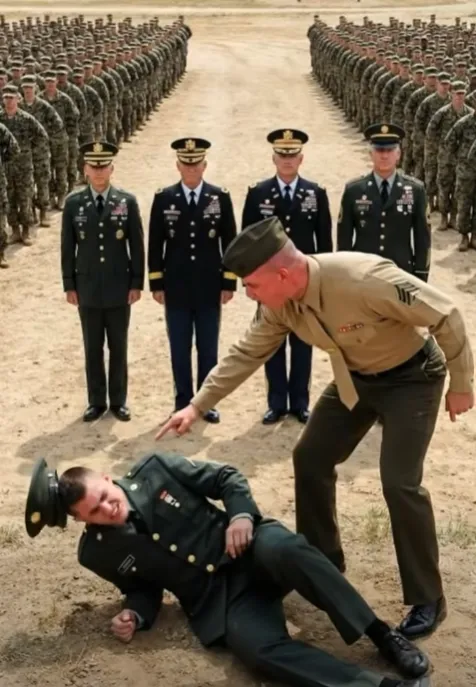
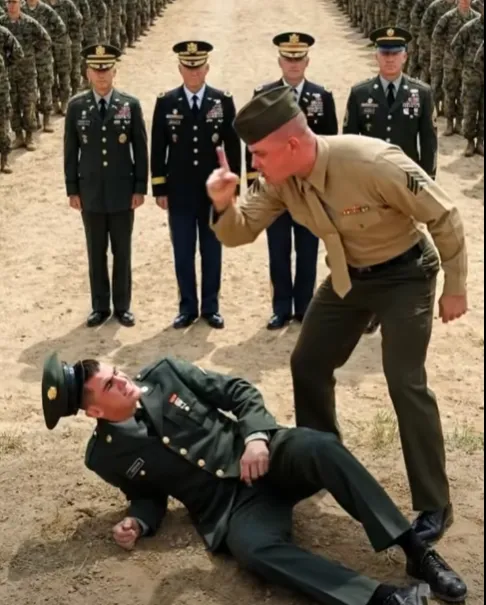
Harlan’s fist came across with full rotation. No restraint.
The crack of impact cut through the air.
Daniel’s head snapped sideways. He hit the ground hard enough that dust lifted around him. His helmet rolled three feet away.
Silence.
Thirty trainees locked in place.
Blood touched the corner of Daniel’s mouth.
“Stay down,” Harlan barked, stepping forward. “This isn’t a daycare. Stay where you belong.”
The words hung heavier than the punch.
To anyone watching from a distance, it might have looked like intensity. Hard training. Toughening a recruit.
But everyone in that formation knew the difference between controlled force and ego.
Daniel stayed on the ground for three seconds.
Not stunned.
Not dazed.
Three seconds exactly.
His breathing slowed. He rolled once onto his side and rose to one knee. He wiped blood from his lip with the back of his glove.
His eyes did not settle on Harlan.
They moved past him.
Toward the observation tower near the edge of the range.
Harlan smirked. “That it? You done?”
Daniel didn’t answer.
Because seven minutes earlier, before the drill began, he had completed a routine equipment check on the range-issued tablet.
During that check, he entered a coded procedural marker.
It wasn’t labeled as a complaint.
It wasn’t dramatic.
It was a quiet designation tied to a secure review protocol.
One that bypassed instructors.
One that alerted command.
The engines were the first sign something was different.
Low. Heavy. Approaching fast.
Four black SUVs crossed the perimeter line without stopping.
No one had called a halt yet.
But everyone stopped moving.
The vehicles drove directly onto Training Ground Charlie and parked in formation.
Doors opened in sequence.
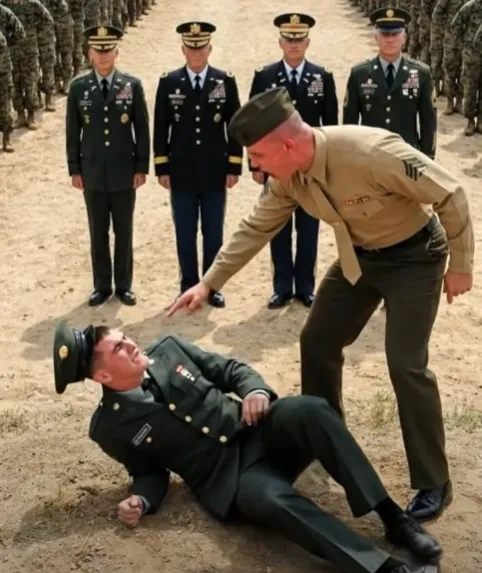
Four full colonels stepped out.
No aides. No public affairs. No visible anger.
Just authority.
Every instructor snapped to attention.
Harlan stiffened half a beat too late.
Colonel James Rowe walked forward with steady steps. His eyes scanned the formation once before landing on Daniel… then on the blood.
“Cease training,” he said calmly.
Medical personnel—who had arrived with the convoy—moved immediately. Daniel was examined. Jaw stable. Minor laceration. No concussion signs.
He waved off further assistance and stood back in formation.
Rowe turned toward Harlan.
“Staff Sergeant. Step forward.”
Harlan obeyed. “Sir, corrective engagement during close-quarters escalation—”
“Stop,” Rowe said evenly.
Colonel Denise Harper approached the command table and accessed the range tablet. She entered a secure code.
The screen shifted from standard drill logs to restricted designation.
A pre-flagged embedded evaluation.
Daniel Reeves was not just a trainee.
He was part of a cross-service oversight initiative—inserted quietly into standard training rotations to assess instructor conduct under unscripted pressure.
His role was not to provoke.
It was to observe.
To document.
To verify escalation patterns that had been reported—but never proven.
Harper didn’t raise her voice.
“We have prior notations,” she said. “Verbal intimidation. Physical escalation exceeding parameters. Informal complaints. No sustained documentation.”
She turned the screen toward Rowe.
“The strike today exceeded authorized contact thresholds. Audio confirms statement: ‘Stay where you belong.’”
The desert wind carried nothing.
Harlan’s posture shifted—not defensive, but calculating.
“Sir, combat readiness requires—”
“This,” Rowe interrupted, “requires discipline.”
He didn’t shout.
He didn’t threaten.
He simply said, “You are relieved.”
By 1200 hours, Harlan’s access credentials were suspended. His sidearm logged. His duties reassigned pending formal review.
No public spectacle.
Just administrative finality.
Daniel was called to the command tent afterward.
“You may withdraw from the program,” Harper told him. “You’ve completed the required confirmation.”
“I intend to finish training,” Daniel replied.
Rowe studied him for a long moment.
“Under direct oversight,” he said.
Daniel nodded once.
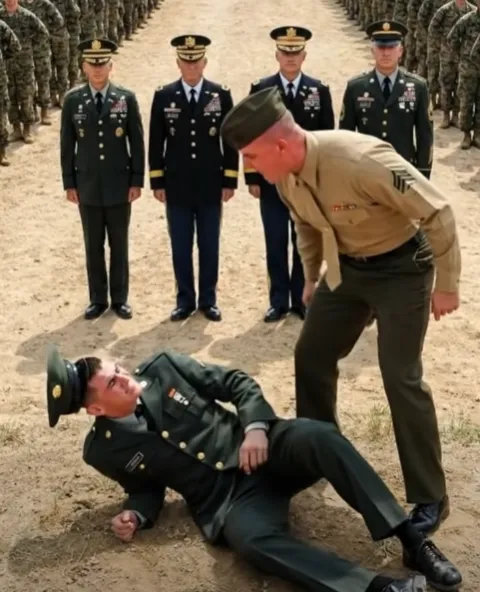
The change on Training Ground Charlie was immediate—but unspoken.
Corrective feedback became verbal before physical.
Engagement limits were restated clearly.
Documentation increased.
No announcements were made.
But the culture shifted.
Ninety days later, the review board finalized its findings.
Pattern confirmed. Authority misused. Escalation normalized.
Harlan’s discharge was upheld. Instructor credentials revoked. Case logged as training precedent.
No speeches followed.
Precedent doesn’t require applause.
Daniel completed the program.
Graduated without distinction beyond regulation.
Accepted his insignia with the same composure he’d shown the day he took the punch.
He transferred units months later.
Continued his work.
Filed reports when necessary.
Never attached his name to the directive Fort Meridian issued the following year:
Instructor conduct would be evaluated with the same rigor as trainee performance.
New recruits rotated through Training Ground Charlie after that.
They trained hard.
They were pushed.
But the line was visible now.
And no one crossed it casually.
Years later, when someone asked Daniel about that morning, he answered simply:
“Standards don’t protect people. Enforcement does.”
He never described himself as brave.
He called himself prepared.
And in the military, that difference matters.
Because real change doesn’t arrive with shouting.
Sometimes it arrives quietly.
Waits.
And documents everything.
My Husband Held His Mistress’s Hand at My $100,000 Funeral—Then I Walked In Carrying the Lock They Used to Kill Me 029
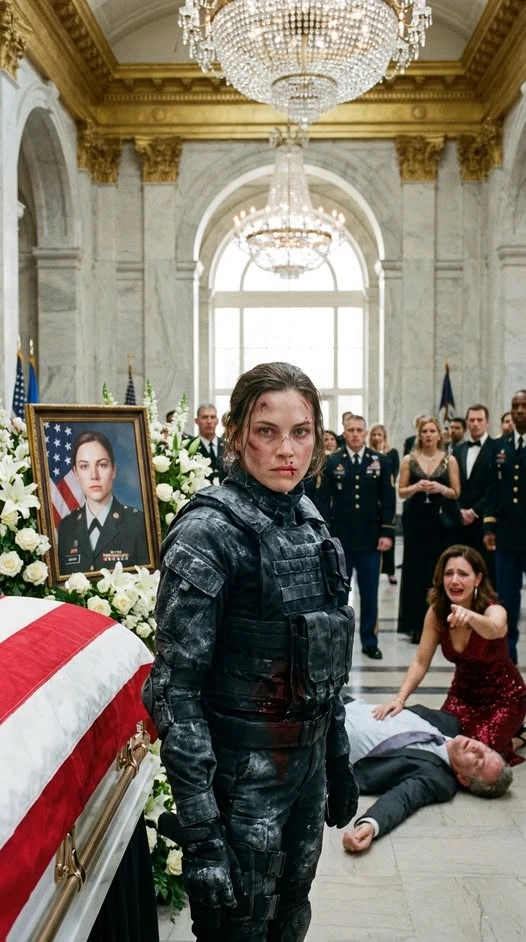
My family was hosting a lavish $100,000 memorial service for me, weeping over an empty mahogany casket. My husband was already holding his mistress’s hand, whispering about how they’d spend my military life insurance. They thought locking me in that abandoned cabin to freeze was a foolproof plan to steal my assets. They forgot I was a Special Forces survival instructor. The priest was midway through his eulogy when the heavy cathedral doors slammed open. I walked down the aisle, still covered in snow and blood, holding the iron padlock they used to trap me. “Sorry I’m late to my own funeral”
Gavin called this trip an “anniversary getaway” to repair our marriage. He drove us deep into the unforgiving, jagged mountains of Montana, to a defunct, isolated cabin completely off the grid.
But the moment I stepped inside to drop my bags, the heavy pine door suddenly slammed shut behind me.
Clack! The horrifying, metallic screech of a heavy iron padlock sliding into place cut through the howling wind outside.
“Gavin!” I screamed, lunging forward to pound my fists against the thick wood. “Open the door! This isn’t funny!”
I rushed to the cracked windowpane and wiped away the frost. My heart stopped. Outside, standing on the porch as a violent blizzard rolled over the peaks, Gavin wasn’t alone. Leaning into him, wrapped in an expensive white fur coat, was Alyssa—the glamorous mistress whose crimson lipstick I had found smeared on his legal documents.
Gavin held up his hand, smirking. In his palm rested my military satellite phone and my heavy winter parka. He had meticulously stripped me of my survival gear while packing the truck.
“It was never about your career or us, Morgan!” Gavin shouted over the wind, the absolute, cold-blooded indifference in his eyes screaming volumes. “It was about the money. The military life insurance, the house, the pension. You’re worth so much more to me dead than alive.”
“Let’s go, babe,” Alyssa giggled soullessly. “It’s freezing out here, and we have a hundred-thousand-dollar memorial service to plan.”
Gavin offered one last, mocking smile. “By tomorrow morning, the blizzard will have done my job for me. Rest in peace, Lieutenant.”
They turned in unison, leaving me entirely alone as the sub-zero temperatures seeped into the dark cabin. I sank to the dusty floorboards. The man I had sworn to love had just signed my death warrant with a smile.
But the paralyzing grief only lasted a single minute.
I closed my eyes. I took a deep, shuddering breath, letting the freezing air fill my lungs. And when I opened my eyes, the weeping, betrayed wife was dead. They had meticulously set a trap, but they forgot one crucial detail: I am a Special Forces survival instructor. And you cannot freeze a fire.